
Passau – Donaueschingen (Epilogo)
30 agosto
La Serenella lì l'abbiamo lasciata e lì dobbiamo andare a riprendercela. Necessariamente in treno, con un viaggio di sei ore e 230 euro attraverso la Baviera e il Baden-Wurttemberg. Un sacco di tempo per tirare le fila di questa seconda, piccola impresa ciclistica familiare.
Di fatto le fila le abbiamo tirate tutti e tre ieri sera, di fronte a birra, salsicce e salsine bavaresi durante la nostra penultima cena in Germania. Ognuno con le sue considerazioni, pensieri, desideri e timori per future imprese più toste di questa. Io qui riporto il mio pensiero e preferisco evitare di riprendere i punti di vista degli altri due compagni di viaggio che, se vorranno, potranno integrare con il proprio punto di vista queste poche righe.
Ecco qui in sintesi quello che sento di aver imparato:
- La voglia di girare il mondo in bici c'è ancora e, semmai, è cresciuta
- Dobbiamo certamente migliorare il nostro rapporto con la gente che incontriamo, essere meno chiusi in noi stessi, parlare con la gente, condividere storie
- Bisogna pianificare in anticipo le soste, sia per tirare il fiato e ricordarci come si fa a camminare, sia per non passare nel mondo senza neanche sapere cosa si è visto
- La lingua è un problema e non possiamo assumere che con l'inglese se ne venga sempre fuori. Un minimo di conoscenza e un dizionario bisogna averli
- Bisogna diventare più indipendenti con il vitto. Cenare in ristorante è sempre un piacere, ma non deve essere un obbligo
- Abbiamo fatto grandi passi in avanti con le salite. Bisogna farne ancora tanti.
- Ci sono una serie di miglioramenti tecnici necessari che non starò ad elencare, limitandomi al principale: dobbiamo essere in grado di pedalare sotto (quasi) qualunque acquazzone. Se uno può li evita, aspetta, prende un treno, ma se non può deve poter pedalare.
Per il momento andiamo avanti che di tempo, avanti, ce n'è.
Piccolo epilogo sui pedalanti del fiume.
La ciclabile del Danubio è famosa e battuta, certamente a ovest di Budapest. è inevitabile che, in un giro come questo, incontri più e più volte le stesse persone nei campeggi, negli ostelli, per strada. E anche se non ti conosci, inizi a salutarti e ti sembra, in qualche modo, di fare amicizia. Sono occasioni preziose di contatto umano che, se esplorate come si deve, possono dare di più della strada fatta, dei paesaggi, della storia delle città.
Puroppo noi esseri umani del XX-XXI secolo siamo ricci, la pancia morbida e la scorza spinosa. Si fa fatica a dire ciao, da dove vieni?, dove vai?, ci beviamo una birra insieme?, raccontami la tua storia. Non si fa, ed è un peccato, nel senso religioso del termine. Passiamo tre quarti di secolo su questo pianeta e alla fine della vita avremo parlato sì e no con l'1% delle persone che incontriamo.
In quest'aspetto, come detto sopra, vogliamo migliorare per il futuro, iniziando dai giri in bici, che poi il resto vien da sé. E iniziamo qui, con lo spennellare qualche ritratto acquarellato di incontri ripetuti, e non, di questo giro.
Di Anna, la ciclista del trentino abbiamo parlato. Non abbiamo la sua foto, ma il numero di telefono sì. Chissà...
Poi ci sono Dieter e Susan, svizzeri, partiti da Schaffausen e diretti a Budapest, su una bici-tandem orizzontale dove lui pedalava dietro in posizione eretta e lei davanti sdraiata. Mi hanno confessato, però, che in salita non è che sia uno spasso. Li abbiamo visti per la prima volta a Dillingen in campeggio e poi abbiamo continuato a incontrarci per strada, nei paesi, agli incroci. Anche ieri, prima di Passau, dove finalmente abbiamo avuto quel po' di coraggio per chiedere di fare una foto insieme.
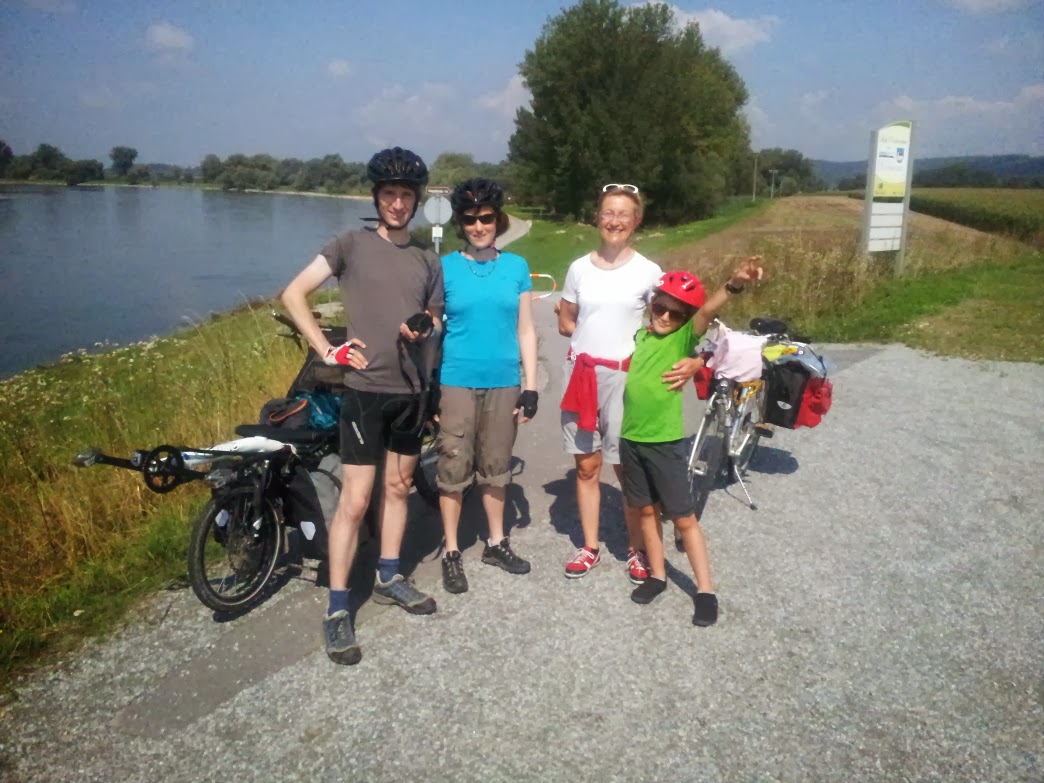
Dieter, Susan e la loro bici-tandem-sdraio
Sara, Lena e Louise le abbiamo incontrate all'ostello di Ingolstadt, la giornata della pioggia battente. Sono entrate zuppe come stracci ma ancora vispe dopo 80 km passati in condizioni impossibili. Da lì le abbiamo incontrate praticamente ogni giorno fino a ieri, quando le ho riviste mentre entravo all'ostello di Passau, con la vista annebbiata dalla salita killer. La foto ricordo l'abbiamo fatta stamattina dopo colazione, prima che loro partissero per Vienna mentre noi no.
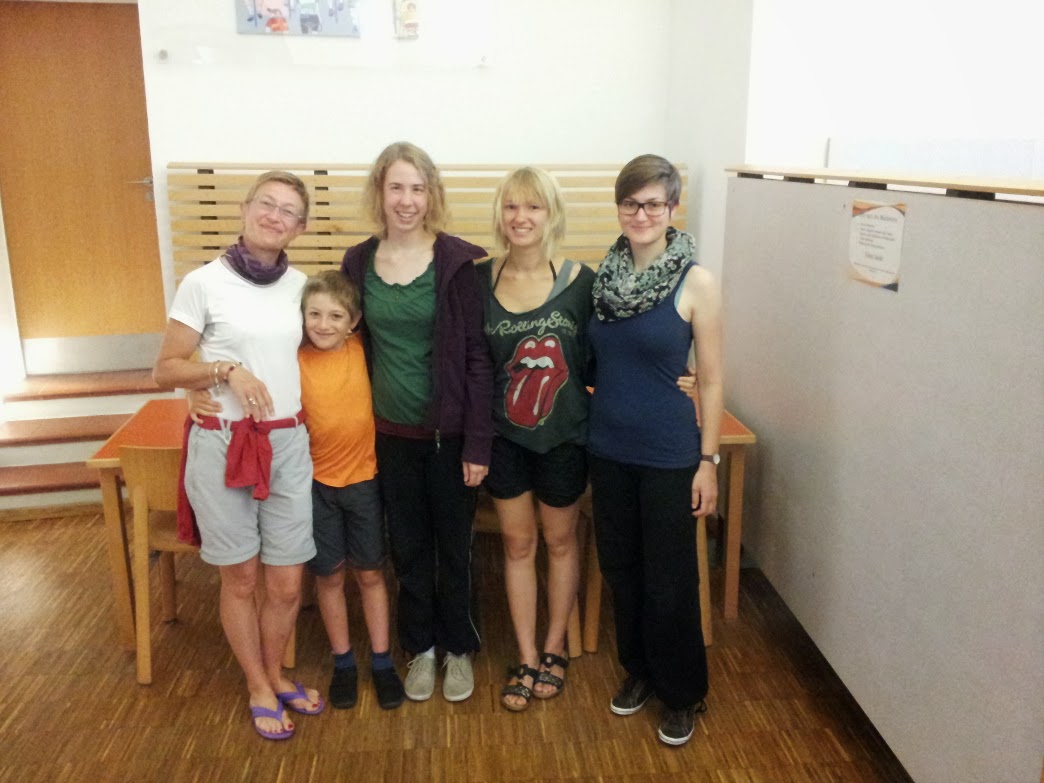
Donne d'acciaio (e un intruso)
Poi ci sono i due amici inglesi, ai quali non abbiamo chiesto il nome, incontrati al campeggio di Wörth. Già maturetti (come se noi fossimo giovincelli di primo pelo) hanno affrontato l'acquazzone e ce li siamo ritrovati all'ostello di Ingolstadt. La mattina, a colazione, ci hanno dato preziosissimi consigli tecnici per pedalare con il brutto tempo. No matter what you'll get wet. The important is to stay warm sono l'estrema sintesi.
E poi un paio di famiglie che pedalavano campeggiando postandosi dietro l'impossibile: figli plurimi, dal poppante al quasi adolescente, tenda multi-stanza, monti di borse, carrellino. Il giorno che vedrò una famiglia italiana fare una vacanza simile in quelle condizioni saprò che il giorno del giudizio è vicino.
Un personaggio che avrei voluto avvicinare ma mannaggia la timidezza è stato un ragazzo Ceco che viaggiava con una bici dotata di motore ausiliario elettrico alimentato a energia solare. I pannelli solari per caricare le batterie, orientabili, occupavano un carrello lungo il triplo della bici realizzato artigianalmente e dal dubbio equilibrio. Mi sono domandato che senso avesse avere un motore ausiliario se poi, per alimentarlo, uno deve portarsi dietro tutto quel carnevale. Mannaggia la timidezza, appunto, e la mia domanda non ha avuto risposta.
E ancora un tizio che il Danubio se lo camminava, invece di pedalarselo, portandosi la sua roba non in uno zaino, ma in un carretto trainato a mo' di cavallo. E una signora che come bici aveva una Graziella (una Graziella!, senza cambio) caricata all'inverosimile che ogni tanto vedevo ferma sulla sponda del torrente che se la dormiva (e ci credo).
E chissà quante altre storie ci sono passate accanto in questi dodici giorni. Un universo al paragone del quale il giro del pianeta in bici pare una passeggiata nel giardino di casa.
Epilogo all'epilogo
Tutto avrei immaginato della Germania tranne che avrei rimpianto le Ferrovie dello Stato italiane. E invece è successo, in un finale a sorpresa che neanche Fantozzi o Paperino avrebbero saputo far di meglio.
Il dramma si consuma nel ritorno Passau-Donaueschinghen in treno, pianificato sul sito della Deutsche Bahn in tre parti: Passau-Monaco, Monaco-Ulm, Ulm-Donaueshingen. Partenza ore 12:26 arrivo ore 18:36.
La partenza è in orario, ma l'arrivo a Monaco no. Mezz'ora di ritardo che ci brucia la coincidenza per Ulm. Poco male, dice la bigliettaia, prendete il regionale successivo ed arriverete a destinazione alle 20:36. In sostanza due ore dopo per mezz'ora di ritardo. Pazienza, siamo in vacanza, chi se ne frega.
Il regionale per Ulm è stipato a sardine e riusciamo a infilare le bici per miracolo, tranne la mia che tengo, in piedi, fuori dal WC del vagone sperando di non incontrare la controlloressa Valchiria che stavolta mi scaraventa fuori sul serio. Ad Augsburg sentiamo un annuncio in tedesco, il treno si svuota ed inizia a procedere lento, ma lento, che più lento non si può. A un certo punto ho un dubbio: che cacchio hanno detto prima? Staremo andando a Ulm? La risposta ci svela l'inverosimile: ad Augsburg il treno si è diviso: metà ha proseguito verso Ulm, a ovest, mentre l'altra metà (ovviamente la nostra) se ne va tranquillo come una Pasqua verso Aalen, un paesino insignificante a nord, totalmente fuori strada. Due ore per fare 110 km.
Non potendo fare altro aspettiamo e stendiamo un piano di contrattacco. Alla fine decidiamo di prendere un treno che da Aalen ci porti a Ulm (verso sud), da lì uno che porti a Singen (verso sud-ovest) e da Singen l'ultimo treno possibile verso Donaueschingen (a nord-ovest). Il tutto con tre coincidenze mozzafiato.
Ad Aalen perdiamo il primo treno per Ulm (troppo pieno) ma riusciamo a prendere il secondo, che riduce il nostro margine coincidenze ma rende l'impresa ancora possibile. A Ulm raggiungiamo il culmine del paradosso. Scendiamo dal treno (noi, le bici, le borse, ecc) giusto il tempo per accorgerci che la stessa carrozza da cui siamo scesi ha cambiato destinazione per Singen (la nostra) e si sta riempiendo di gente. Meri si lancia all'assalto frontale e, mentre carica la bici sul treno, che nel frattempo si è riempito, infila un piede in uno spazio di 20 cm fra il predellino e il marciapiede finendo con tutta la gamba giù fino al binario e prendendo una craniata contro la porta del treno. Mentre viene aiutata a salire da un paio di pendolari io mi lancio, preoccupato, al salvataggio. Mentre faccio per salire raddoppio l'impresa sprofondando con la gamba sinistra prendendo una tibiata al bianco dell'osso. In pratica ci troviamo sullo stesso treno da cui siamo scesi cinque minuti prima ma con pezzi di salute che se ne sono andati rotolando fra i binari.
Il treno parte con cinque minuti di ritardo, si ferma appena fuori dalla stazione e poi rientra. Poi riparte. Alè, già 15 minuti di ritardo in partenza, che mette fuori gioco la coincidenza a Singen, che è di soli sette minuti. Ciccio è già tutto allegro e si pregusta la nottata in stazione, che dopo aver pagato 230 euro per questo viaggio dannato piuttosto che pagare un albergo faccio il barbone.
Bisogna dire che, una volta partito, il treno vola come un treno e recupera un bel po' del ritardo. Arriviamo a Singen con tre minuti per passare dal binario 8 al binario 1 (con le bici, borse, eccetera). Impartisco le direttive e lancio Meri e il Ciccio verso l'ascensore più vicino per seguirli io in seconda battuta. Quasi subito, però, li fermo: il binario 8 non è dall'altra parte della stazione (come era logico aspettarsi) ma perfettamente adiacente al binario 1. Ci è mancato un soffio che vedessimo passare il nostro treno stando dalla parte sbagliata della stazione.
L'ultimo tratto, fortunatamente, è senza storia. Arriviamo alle 23:40, praticamente 11 ore dopo, avendo percorso la Baviera e il Baden-Wurttemberg in tutte le direzioni possibili. Siamo digiuni, ma questa volta il Padreterno ci dà una mano, mentre se la ride fino alle lacrime, e ci fa trovare un Kebap aperto dove si spariamo una pizza prima di attaccare con l'ultimo tratto in bici e il ritorno in auto.
Da Donaueschingen al campeggio dove abbiamo lasciato la Serenella sono 7 km di strade campestri che percorriamo ormai a notte fonda e, in qualche modo, ringraziamo le sventure del viaggio per questo regalino finale pieno di fascino.
August 30
That’s where we left Serenella, and that’s where we must go back to pick her up. Necessarily by train, with a six-hour ride and 230 euros through Bavaria and Baden-Württemberg. Plenty of time to wrap up this second, little family cycling adventure.
In fact, we already wrapped it up yesterday evening, all three of us, in front of beer, sausages, and Bavarian sauces during our penultimate dinner in Germany. Everyone with their own thoughts, desires, and worries about tougher trips yet to come. I’ll just report my own here and avoid repeating those of my two travel companions who, if they wish, can add their points of view to these few lines.
Here’s, in short, what I feel I’ve learned:
- The urge to travel the world by bike is still there—and if anything, it’s grown.
- We definitely need to improve our relationship with the people we meet, be less closed in on ourselves, talk to people, share stories.
- We have to plan stops in advance, both to catch our breath and to remind ourselves how to walk, and to avoid passing through the world without even knowing what we’ve seen.
- Language is a problem, and we can’t assume English will always get us through. We need at least a little knowledge and a dictionary.
- We must become more independent with food. Dining in restaurants is always a pleasure, but it shouldn’t be an obligation.
- We’ve made big progress on climbs. But we still have a long way to go.
- There are several technical improvements needed that I won’t list, except for the main one: we need to be able to pedal through (almost) any downpour. If you can avoid it, fine. If not, you should still be able to ride.
For now, let’s just keep going. There’s still time ahead.
Short epilogue on the river pedalers.
The Danube cycle path is famous and crowded, at least west of Budapest. It’s inevitable that on a trip like this you run into the same people again and again—at campsites, hostels, or on the road. Even if you don’t know them, you start greeting each other, and somehow it feels like friendship. These are precious chances for human contact that, if explored properly, can give more than the road, the landscapes, or the city history.
Unfortunately we 20th–21st century humans are hedgehogs: soft bellies, prickly shells. It’s hard to say: hello, where are you from? where are you going? want a beer together? tell me your story. We don’t do it, and it’s a pity—in the religious sense of the word. We spend three-quarters of a century on this planet and by the end of our lives we’ll have spoken to maybe 1% of the people we meet.
That’s something we want to improve in the future—starting with bike tours, and then the rest will follow. So let’s begin here, sketching a few watercolor portraits of people we met more than once (and some we didn’t) on this trip.
We’ve already talked about Anna, the cyclist from Trentino. We don’t have her photo, but we do have her phone number. Who knows…
Then there were Dieter and Susan, Swiss, who left from Schaffhausen and were heading to Budapest on a recumbent tandem bike where he pedaled upright in the back and she reclined in the front. They confessed, though, that uphill it wasn’t much fun. We first saw them at a campsite in Dillingen, then kept bumping into them on the road, in towns, at intersections. Even yesterday, before Passau, where we finally gathered the courage to ask for a photo together.
Dieter, Susan, and their tandem-lounger
Sara, Lena, and Louise we met at the hostel in Ingolstadt, on the day of torrential rain. They arrived soaked like rags but still lively after 80 km in impossible conditions. From then on we practically saw them every day until yesterday, when I spotted them as I staggered into the hostel in Passau, vision blurred from the killer climb. We got a souvenir photo this morning after breakfast, before they set off for Vienna while we didn’t.
Women of steel (and an intruder)
Then there were two English friends, whose names we never asked, whom we met at the campsite in Wörth. Already a bit “seasoned” (as if we were youngsters ourselves), they braved the downpour and we found them again at the hostel in Ingolstadt. Over breakfast they gave us precious technical tips for riding in bad weather. “No matter what, you’ll get wet. The important thing is to stay warm.” That’s the short version.
And then a couple of families traveling by bike while camping, hauling the impossible: multiple kids from babies to near-teens, multi-room tents, mountains of bags, a trailer. The day I see an Italian family on a holiday like that, in those conditions, I’ll know Judgment Day is near.
One character I’d have loved to approach—but damn my shyness—was a Czech guy traveling with a bike equipped with an electric motor powered by solar energy. The solar panels to charge the batteries, adjustable, stretched over a trailer three times the length of the bike, homemade and of questionable balance. I wondered what sense it made to have an auxiliary motor if you then had to drag that entire carnival around just to feed it. Damn my shyness again—my question remained unanswered.
And another guy who was walking the Danube instead of cycling it, hauling his stuff not in a backpack but in a cart hitched like a horse. And a lady whose bike was a Graziella (yes, a Graziella! without gears) loaded to the brim, who I occasionally saw napping by the riverbank (and no wonder).
And who knows how many more stories passed by us in these twelve days. A universe compared to which cycling around the planet seems like a stroll in the garden.
Epilogue to the epilogue
The last thing I expected in Germany was to miss the Italian State Railways. But it happened, in a finale so absurd that even Fantozzi or Donald Duck couldn’t have done better.
The drama unfolds on the return trip Passau–Donaueschingen by train, planned on the Deutsche Bahn site in three parts: Passau–Munich, Munich–Ulm, Ulm–Donaueschingen. Departure 12:26, arrival 18:36.
Departure was on time, arrival in Munich wasn’t. Half an hour late—just enough to miss the Ulm connection. No big deal, said the ticket lady, take the next regional train and you’ll arrive at 20:36. Two extra hours for half an hour’s delay. Whatever, we’re on holiday, who cares.
The regional train to Ulm was packed like sardines and we barely squeezed in the bikes—except mine, which I had to hold upright outside the toilet, hoping not to run into Valkyrie the ticket inspector who’d surely have thrown me off this time. At Augsburg there was an announcement in German, the train emptied out, and then started crawling at snail’s pace. At some point I got suspicious: what the hell did they say earlier? Were we even going to Ulm? The answer was unthinkable: at Augsburg the train had split—half went on to Ulm (west), while our half cheerfully headed to Aalen, a random small town to the north, completely off track. Two hours for 110 km.
With no choice, we waited and plotted a counterattack. In the end we decided to take a train from Aalen to Ulm (south), then one from Ulm to Singen (southwest), and from Singen the last possible train to Donaueschingen (northwest). Three razor-thin connections.
At Aalen we missed the first train to Ulm (too full) but caught the second, which cut our margin but still kept the mission possible. At Ulm we hit peak absurdity. We got off the train (us, bikes, bags, etc.), only to realize that the very same carriage we’d just left had switched destination to Singen (our route!) and was filling up with people. Meri charged in, loading her bike, when her foot slipped into a 20 cm gap between the step and the platform, sending her whole leg down to the tracks and smacking her head against the train door. Two commuters helped her up while I rushed to the rescue, only to replicate the feat myself—my left leg sinking down and my shinbone smashing into the edge. So we ended up back on the same train we’d just left, with a few pieces of health left behind between the tracks.
The train left five minutes late, stopped just outside the station, then rolled back in. Then left again. Hooray—already 15 minutes late, which killed our seven-minute connection in Singen. Ciccio was grinning, already savoring a night in the station, because after paying 230 euros for this cursed trip there was no way I’d pay for a hotel—I’d rather sleep rough.
To be fair, once it got going, the train sped like, well, a train, and made up a lot of lost time. We reached Singen with three minutes to switch from track 8 to track 1 (with bikes, bags, etc.). I barked orders and launched Meri and Ciccio toward the nearest elevator, planning to follow behind. But almost immediately I stopped them: track 8 wasn’t across the station, as logic suggested, but right next to track 1. We almost watched our train leave from the wrong side of the station.
The last leg, fortunately, was uneventful. We arrived at 23:40, after 11 hours, having crossed Bavaria and Baden-Württemberg in every possible direction. Starving, but this time the Lord lent a hand—while laughing himself silly—and provided an open kebab joint where we wolfed down a pizza before the final stretch by bike and then the car ride home.
From Donaueschingen to the campsite where we’d left Serenella it was 7 km of country roads, now in deep night. Somehow we thanked the misadventures of the journey for this final little gift, full of charm.