Dillingen – Donauwörth (41,5 km)
24 agosto
È una tappa medio-lunga, 45 km, fra campi di mais, verza, grano. Siamo in pianura, poco diversa dalla Padana, se trascuriamo le collinette a basso-rilievo che coronano la valle del Danubio.
Il fiume non lo vediamo spesso. Qualche tratto è lungo le sue rive, ogni tanto lo attraversiamo. È completamente diverso dal poco-più-che-torrente che ci ha accompagnato fino a Ulm; qui è già un bel fiumotto, anche se siamo a 2500 e passa km dalla foce, come ci ricordano ogni tanto i cartelli piazzati lungo le sponde. Già, perché il Danubio è l'unico fiume la cui distanza si conta dalla foce, visto che la sorgente non è ben definita. C'è chi dice che coincida con la sorgente del Breg, vicino a Furtwange, mentre c'è chi la vuole coincidente con la sorgente del Brigach, a Donaueschingen. Una cosa certa è che, poco dopo Donaueschingen, Breg e Brigach si incontrano, si abbracciano e dimenticano i rispettivi nomi, ribattezzandosi in "Danubio". Altra certezza è la foce, nel Mar Nero, da cui di conta la distanza. E ciascuno metta poi la fine dove gli pare.
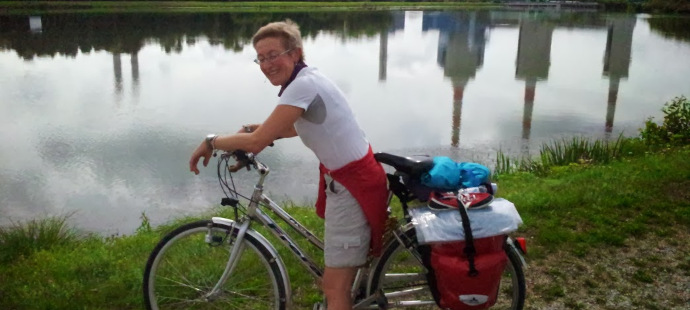
 Fiumotto, brutte ciminiere e bella ciclista
Salite quasi non se ne vedono, ma Franci è in crisi. È un po' che dice che gli fa male la schiena e ultimamente fa fatica anche a mantenere la nostra velocità di crociera standard di 15 km/h. Uno dei problemi è certamente il manubrio, che dovrebbe essere un po' più alto; provo ad intervenire ma l'unico risultato che ottengo allentando la vite centrale è di far ballare il manubrio. Temo il peggio ma poi, stringendo a morte la vite, tutto torna come prima.
Un po' più oltre mi viene un'idea: gli tolgo le borse e me le carico io. È stato come sbloccare un freno a mano. Il mal di schiena passa e torna allegro a pedalare come un fulmine. In realtà non gli va molto giù di sentirsi scarico e protesta un po', ma la differenza è tale che non c'è storia. Io invece le sue borse le sento, eccome, e mi pare che il freno a mano sia passato dalla sua bicicletta alla mia.
Sera, a Donauwörth.
Due passi dopo cena per aspettare l'acquazzone che ci faccia tornare in tenda belli bagnati e pronti per la tappa di domani che mette pioggia a catinelle. Il paese, come tutti gli altri che abbiamo attraversato, è lindo, pulito, con le case pittate di fresco di colori pastello una diversa dall'altra. Scritte sui muri neanche a pagarle. O pitturano le case a ogni cambio di stagione, oppure i tedeschi esistono davvero. Optiamo per la seconda ipotesi. L'altra caratteristica è la quasi totale assenza di esseri viventi. Dopo le 19 non c'è in giro nessuno, e le case sembrano tutte vuote. Ma dove se ne va il sabato sera tutta la gente, anche solo per una sbronza? Mistero.
Inizia a piovere per bene e questo è il segnale del ritorno. Montiamo in bici e sbagliamo pure strada per essere sicuri di beccarci tutto lo scroscio senza perdere neppure una goccia. Arriviamo che inizia a spiovere. Tempismo perfetto.
August 24
A medium-long stage today, 45 km, through endless fields of corn, cabbage, and wheat. We’re on the plain now, not so different from the Po Valley—if you overlook the low rolling hills crowning the Danube valley.
We don’t actually see the river that often. Sometimes we ride along its banks, every now and then we cross it. It’s completely different from the barely-more-than-a-stream that kept us company up to Ulm; here it’s already a proper river, even though we’re still 2,500-plus km from the mouth—as the signs along the banks keep reminding us. Because yes, the Danube is the only river measured backwards, from its mouth, since its source isn’t all that clear. Some say it starts at the spring of the Breg, near Furtwangen, while others swear it’s the Brigach, at Donaueschingen. One thing is certain: shortly after Donaueschingen, the Breg and the Brigach meet, embrace, and forget their old names, baptizing themselves “Danube.” Another certainty is the mouth, in the Black Sea, from which the distances are measured. And then everyone can decide for themselves where the “end” really is.
Big river, ugly smokestacks, and a pretty cyclist
Climbs are almost non-existent, but Franci is in trouble. He’s been saying for a while that his back hurts, and lately he struggles to even keep up with our modest cruising speed of 15 km/h. One obvious problem is the handlebar, which should really be a bit higher. I try to fix it, but the only result of loosening the central bolt is to make the handlebar wobble around. I fear the worst, but then, by tightening it to death, everything goes back to how it was.
A little further on, I get an idea: I take his panniers off and load them onto my bike. It’s like releasing the handbrake. His back pain vanishes and he’s happily pedaling like lightning again. Truth be told, he’s not thrilled about feeling “unloaded” and grumbles a bit, but the difference is undeniable. I, on the other hand, definitely feel his bags—and it seems the handbrake has simply moved from his bike to mine.
Evening, in Donauwörth.
A little walk after dinner, waiting for the downpour that will send us back to the tent nicely soaked and ready for tomorrow’s stage, which promises buckets of rain. The town, like all the others we’ve passed through, is spotless, freshly painted, pastel-colored houses, each in a different shade. Not a trace of graffiti anywhere. Either they repaint the houses with every change of season, or Germans really do exist. We’ll go with the second hypothesis. Another striking feature is the near-total absence of living beings. After 7 p.m., there’s no one around, and the houses all look empty. But where do people go on a Saturday night—even just to get drunk? Mystery.
Then it starts raining properly, which is our cue to head back. We hop on our bikes, take the wrong road for good measure, just to make sure we get the full soaking without missing a single drop. By the time we arrive, it’s easing off. Perfect timing.
Clicca sul menu della mappa per scaricare la traccia GPX e per visualizzare l'altimetria