Deggendorf – Passau (63.7 km)
29 agosto
Dachau, Donau, Passau, nomi tedescamente tedeschi, ma che a me suggeriscono qualcosa di esotico, orientale. Sarà per la "u" finale a cui non siamo abituati (a parte i sardi, ma loro sono un po' come i Triestini, italiani per errore) o forse sarà qualcos'altro che non so, ma arrivare a Passau avendo pedalato lungo il Donau (Danubio) mi lascia una gran voglia di andare oltre, a est, sempre più est, per arrivare, come una specie di Cristoforo Colombo al contrario, al punto di partenza. Non quello geografico, ma a un punto più interno che, per qualche ragione, è irraggiungibile e costringe a girarci intorno prendendo strade all'apparenza distanti e insensate.
Andare lontano per capire ciò che hai vicino. Non c'è niente di nuovo in questo, è un concetto trito e ritrito, materiale per romanzi, romanzetti, poesie e canzonette. E se è così ci sarà pure un motivo.
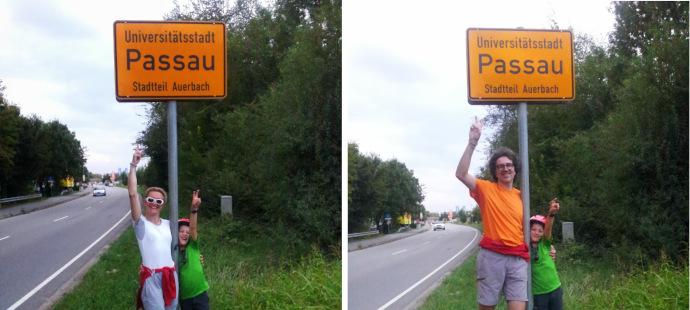
Ora, però a est non si può più andare, a parte quest'ultimo trancio di strada srotolato in una giornata con un sole che non vedevamo dal primo giorno. Dopo aver appestato Don Rodrigo, fatto sposare Renzo e Lucia, terminato i piani per la guerra bambini-genitori e pedato la nostra sessantina di chilometri arriviamo alla fatidica foto sotto il cartello "Passau" che sancisce la fine dell'impresa. Ci siamo arrivati con le nostre gambe, tranne la tappa Donauwörth - Ingolstadt che riteniamo comunque moralmente nostra, perché sconfitti non tanto dal fisico, ma dal tempo tiranno (sia quello atmosferico che non) e dall'inadeguatezza tecnica a cui porremo rimedio per il futuro.

Arrivati (e le bici dove sono?)
All'ultimo, ultimissimo chilometro che ci conduce all'ostello riceviamo il regalino di una salita al 22% di cui la prima metà, impedalabile, su acciotolato. La seconda metà è asfaltata e io e il Ciccio ce la giochiamo. Arriviamo entrambi, io con un polmone di meno, e ne siamo fieri.
Passau è affascinante, distesa come un dito alla confluenza di tre fiumi, l'Inn, l'Ilz e il Danubio che, dopo Passau, se li mangia tutti e ingrassa di un bel po'. Quello che mi affascina, oltre alla città in sé, ricostruita interamente in stile barocco dopo l'incendio del 1662, è il fatto che tre fiumi che non c'entrano niente l'uno con l'altro si incontrino nello stesso punto. Un caso idrogeologico che non credo sia particolarmente frequente.

Passau – tre fiumi in uno
Dall'alto del castello Veste Oberhaus, dove si trova anche l'ostello, la vista è spettacolare. La città vecchia si distende proprio alla confluenza dei tre fiumi e promette bene. Peccato che questa volta ce la dobbiamo godere così, a volo d'uccello, che stasera piuttosto che scendere per poi risalire mi metterei a spaccar pietre. Domattina, poi, abbiamo promesso al Ciccio un giro al museo storico di Passau, che non si dica che con noi si pedala e basta.

Passau – il centro si incunea fra Inn (sullo sfondo) e il Danubio (in primo piano)
Tanto l'anno prossimo da qui ripartiremo, e la chiesa di S. Stefano, con l'organo più grande del mondo, non ce lo leva nessuno.
August 29
Dachau, Donau, Passau—names as German as they come, yet to me they sound almost exotic, oriental. Maybe it’s the final “u,” which we’re not used to (except the Sardinians, but they’re a bit like the Triestini—Italians by mistake), or maybe it’s something else I can’t quite pin down. In any case, reaching Passau after cycling along the Donau (Danube) leaves me with a strong urge to keep going east, always further east, like some kind of backwards Christopher Columbus heading toward the point of departure. Not the geographical one, but a deeper, inner point that—for some reason—remains unreachable, forcing us to circle around it, taking roads that seem distant and senseless.
Going far away to understand what you have close by. There’s nothing new in that—it’s a worn-out idea, fodder for novels, novellas, poems, and songs. And if it’s been repeated so often, there must be a reason.
But now, east is no longer an option, except for this final stretch of road unrolled on a day of sunshine we hadn’t seen since the very first morning. After plaguing Don Rodrigo, marrying off Renzo and Lucia, completing the plans for the children-versus-parents war, and pedaling our sixty-odd kilometers, we arrive at the long-awaited photo under the “Passau” sign, marking the end of our adventure. We got here with our own legs, except for the Donauwörth–Ingolstadt stage, which we still count as morally ours—defeated not so much by our bodies, but by that tyrant Time (both the meteorological and the other kind), and by technical shortcomings we’ll make sure to fix in the future.
We made it (but where are the bikes?)
On the very last, ultimate kilometer leading up to the hostel, we’re treated to a gift: a 22% climb, the first half unrideable on cobblestones. The second half is asphalted, and Ciccio and I go head-to-head. We both make it—me with one lung less—and we’re proud of it.
Passau is fascinating, stretched out like a finger at the confluence of three rivers: the Inn, the Ilz, and the Danube, which swallows them all up after Passau and fattens considerably. What fascinates me, beyond the city itself—rebuilt entirely in Baroque style after the 1662 fire—is the fact that three rivers, completely unrelated to one another, converge at the very same point. A hydrological coincidence that I don’t think is all that common.
Passau – three rivers into one
From the top of Veste Oberhaus castle, where the hostel is located, the view is spectacular. The old town lies right at the confluence of the three rivers and looks full of promise. A pity we have to enjoy it only from above—this evening, rather than go down and then climb back up, I’d sooner break rocks. Tomorrow morning, though, we’ve promised Ciccio a visit to the Historical Museum of Passau—so no one can say that with us it’s all about cycling and nothing else.
Passau – the old town wedged between the Inn (in the background) and the Danube (foreground)
Anyway, next year we’ll start again from here—and nothing will stop us from seeing St. Stephen’s Church, with the largest organ in the world.
Clicca sul menu della mappa per scaricare la traccia GPX e per visualizzare l'altimetria